
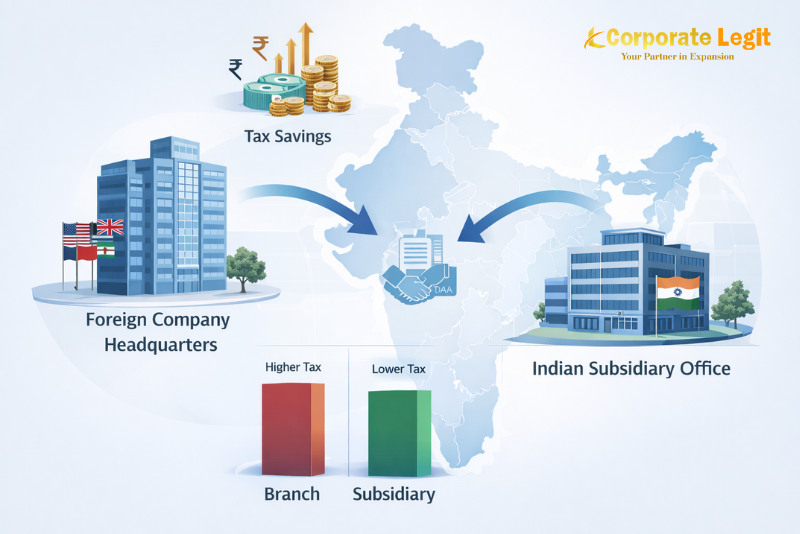
Did you know that foreign companies establishing an Indian subsidiary setup can reduce their effective tax rate by nearly 18% compared to operating as a branch office?
However, many international businesses fail to capitalise on these substantial tax advantages when expanding into the Indian market. Establishing operations through a structured entity in India involves navigating complex tax regulations, but the potential rewards are significant for those who understand the system. Professional advisory support often reveals that companies overlook several tax optimization opportunities, specifically those related to corporate tax rates, dividend taxation, and double taxation avoidance frameworks.
This article explores the hidden tax benefits available to foreign companies establishing an Indian subsidiary setup. We’ll examine the structural options, compliance-linked advantages, and strategic approaches that can help maximise tax efficiency while maintaining full regulatory compliance in the Indian business environment.
Understanding the Indian Subsidiary Structure
The legal foundation of any Indian subsidiary setup begins with its definition and structure. Foreign businesses considering expansion into India must understand these frameworks to maximise both operational efficiency and tax benefits.
- Definition under the Companies Act, 2013
A subsidiary in India refers to a company incorporated under the Companies Act, 2013, where a foreign parent either controls the composition of its Board of Directors or exercises control over more than half of the total voting power. Despite being owned by a foreign entity, once incorporated, the subsidiary is treated as an Indian resident company for all legal and tax purposes.
This structure creates an independent legal persona that can hold assets, enter into contracts, hire employees, and engage in litigation in its own name. Furthermore, the Indian legal system firmly upholds the principle of separate legal identity; even if all shares are owned by a single parent company, the subsidiary remains a distinct entity with its own rights and liabilities.
- Difference between Wholly-Owned Subsidiary and Joint Venture
Foreign companies have two primary options when establishing an Indian subsidiary setup:
- Wholly Owned Subsidiary (WOS): A separate legal entity where 100% of equity shares are held by the foreign parent company or its nominees. This structure provides complete control over operations, management, intellectual property, and strategic decisions.
- Joint Venture (JV): A business arrangement where ownership is shared between a foreign entity and an Indian partner. Capital, resources, risks, and control are distributed according to the JV agreement.
The key distinction lies in autonomy. While a WOS offers full operational independence, a JV provides access to local expertise and networks with shared decision-making authority.
- Eligibility for 100% FDI under the Automatic Route
India regulates foreign investment through the Automatic Route and the Government Approval Route. Under the Automatic Route, foreign investors can establish an Indian subsidiary setup without prior government approval, subject only to post-investment reporting to the Reserve Bank of India.
Numerous sectors permit 100% foreign ownership, including:
- Information Technology and IT-enabled services
- Manufacturing (most sub-sectors)
- Renewable energy
- E-commerce (marketplace model)
- Pharmaceuticals (greenfield)
- Single-brand retail trading
- Telecommunications services
Certain strategic sectors, such as defence, print media, and brownfield pharmaceuticals, remain subject to sectoral caps or approvals.
For a foreign company setup in India, understanding these sectoral regulations is essential for compliant and tax-efficient structuring.
Hidden Tax Benefits Foreign Companies Often Overlook
Foreign entities pursuing an Indian subsidiary setup frequently miss substantial tax advantages that significantly improve long-term profitability and repatriation efficiency.
Foreign companies that engage specialized FDI & FEMA advisory services gain deeper visibility into regulatory-linked tax efficiencies, cross-border structuring options, and treaty-based reliefs that are frequently missed during early-stage planning.
- Lower Corporate Tax Rate for Domestic Subsidiaries
Domestic companies may opt for a concessional corporate tax rate of 22%, resulting in an effective rate of approximately 25.17% after surcharge and cess. This is substantially lower than the nearly 40% tax burden applicable to branch offices of foreign entities.
Manufacturing subsidiaries incorporated after October 1, 2019, may qualify for a further reduced effective tax rate of approximately 17%, provided production commences within the prescribed timelines.
- Exemption from Dividend Distribution Tax Post-2020
The abolition of Dividend Distribution Tax has fundamentally improved profit repatriation. Dividends are now taxed only in the hands of shareholders, allowing foreign parents to claim tax credits in their home jurisdictions and significantly reduce global tax leakage.
- DTAA Benefits for Repatriated Profits
India’s extensive network of Double Taxation Avoidance Agreements enables subsidiaries to benefit from reduced withholding tax rates and foreign tax credits. Proper documentation, including Tax Residency Certificates and Form 10F, ensures smooth treaty benefit claims.
- Transfer Pricing Safe Harbour Advantages
Safe Harbour Rules reduce scrutiny for qualifying intercompany transactions by accepting declared pricing margins within prescribed thresholds. This offers certainty and minimises disputes for service-oriented subsidiaries.
- GST Input Credit Optimisation
Export-oriented subsidiaries can claim refunds or utilise GST input credits efficiently when structured correctly, further improving cash flow and operational margins under an Indian subsidiary setup.
Compliance-Linked Tax Advantages for Indian Subsidiaries
Compliance plays a critical role in unlocking fiscal advantages for entities operating under an Indian subsidiary setup.
Timely filing of Form FC-GPR ensures proper recognition of foreign capital and establishes a clear cost base for future capital gains calculations. Annual submission of the Foreign Liabilities and Assets return strengthens regulatory standing and supports treaty benefit eligibility.
Eligible startups may also benefit from audit exemptions under Section 44AB, reducing compliance costs during early growth stages.
Additionally, SEZ units engaged in service exports can access export promotion incentives and duty-free procurement benefits when structured appropriately.
Strategic Structuring to Maximise Tax Efficiency
Choosing the right legal structure is central to maximising tax benefits under an Indian subsidiary setup.
Private Limited Companies enjoy lower tax rates and are preferred for long-term scalability and external investment, while LLPs offer distribution flexibility but face higher effective taxation.
Intercompany agreements ensure transfer pricing compliance, mitigate withholding risks, and support arm’s length documentation. Capital infusion strategies, whether equity or debt, must be aligned with both FEMA regulations and tax efficiency goals.
Conclusion
Foreign companies entering India can unlock significant tax efficiencies through a well-planned Indian subsidiary setup. Lower corporate tax rates, improved dividend taxation, and access to treaty benefits create compelling advantages over alternative entry structures.
Strategic decisions around entity selection, capital structuring, and compliance execution further enhance these benefits. Companies that proactively manage reporting obligations and align operations with regulatory frameworks gain long-term stability and reduced tax exposure.
As India’s investment landscape continues to mature, foreign businesses that adopt a compliant, well-advised subsidiary model with guidance from Corporate legit position themselves for sustainable growth in one of the world’s most dynamic economies.
Frequently Asked Questions (FAQs)
1. Why is an Indian subsidiary setup more tax-efficient than a branch office?
An Indian subsidiary setup is treated as a domestic company for tax purposes, allowing access to lower corporate tax rates starting at 22%, compared to nearly 40% for branch offices. Subsidiaries also benefit from DTAA relief, better profit repatriation, and GST input credit optimisation, making them significantly more tax-efficient for long-term operations.
2. Can foreign companies own 100% of an Indian subsidiary?
Yes, foreign companies can own 100% of an Indian subsidiary in most sectors under the Automatic Route of FDI. Sectors such as IT, manufacturing, renewable energy, e-commerce (marketplace), and pharmaceuticals permit full foreign ownership without prior government approval, subject to RBI reporting and compliance.
3. How does DTAA benefit foreign companies with Indian subsidiaries?
Double Taxation Avoidance Agreements allow foreign parent companies to reduce withholding tax on dividends, royalties, and technical service fees received from Indian subsidiaries. Taxes paid in India can be claimed as credits in the home country, preventing double taxation and improving global tax efficiency.
4. What compliance filings are mandatory after setting up an Indian subsidiary?
Key compliance requirements include filing Form FC-GPR after share allotment, submitting the annual Foreign Liabilities and Assets (FLA) return, maintaining transfer pricing documentation, and complying with GST, income tax, and corporate law filings. Timely compliance ensures capital recognition and eligibility for tax treaty benefits.
5. Is a Private Limited Company better than an LLP for foreign subsidiaries?
In most cases, a Private Limited Company is preferred for foreign subsidiaries due to lower corporate tax rates, easier access to external funding, and better acceptance by investors and regulators. LLPs may suit businesses prioritising profit distribution flexibility, but typically face higher effective taxation and limited FDI flexibility.