
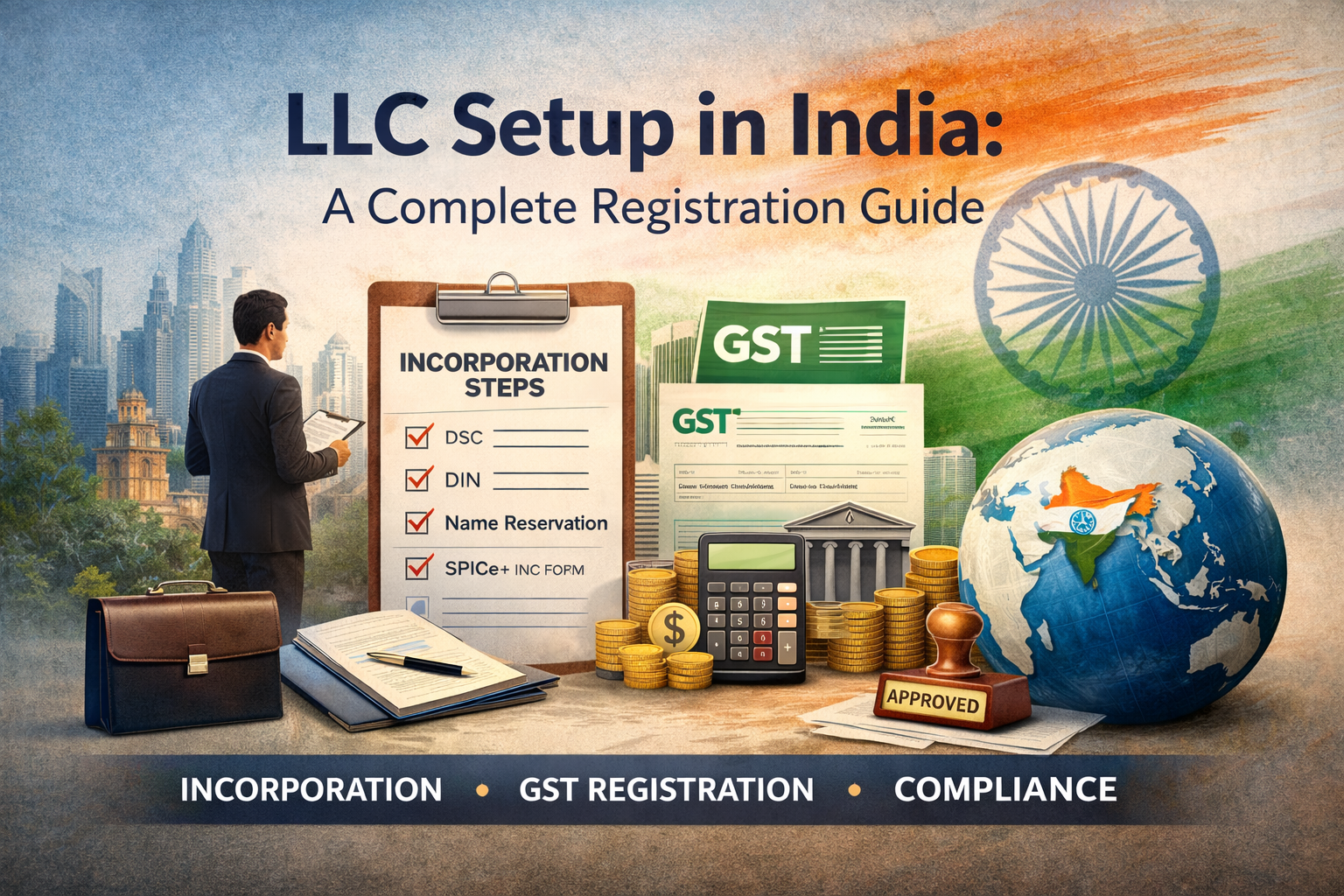
Many international founders search for an LLC Setup in India, expecting the same structure available in other countries. India, however, does not offer a traditional Limited Liability Company. Instead, you can choose between two closely comparable structures:
- Private Limited Company (PLC)
- Limited Liability Partnership (LLP)
Both provide limited liability protection and a separate legal identity. The right choice depends on your funding plans, ownership model, and long-term goals. This guide explains how the process works practically, without unnecessary legal jargon.
What Does LLC Setup in India Actually Mean?
When people talk about LLC Setup in India, they usually mean forming either:
- A Private Limited Company (most common for startups and foreign investors), or
- A Limited Liability Partnership (LLP) (preferred by professionals and small firms).
Both structures protect personal assets. The company or LLP becomes a separate legal person. It can sign contracts, open bank accounts, hire employees, and own property.
Private Limited Company vs LLP
Here’s how they compare:
| Feature | Private Limited Company | LLP |
| Legal Framework | Companies Act, 2013 | LLP Act, 2008 |
| Minimum Members | 2 Directors (1 Indian resident) | 2 Designated Partners (1 Indian resident) |
| Investor Friendly | Yes (easy share transfer) | Limited |
| Compliance Level | Moderate to High | Moderate |
| Ideal For | Startups, tech firms, foreign subsidiaries | Consultants, professionals, small firms |
If you plan to raise funding, expand quickly, or build a scalable structure, a Private Limited Company usually works better for an LLC Setup in India.
Why India Attracts Global Entrepreneurs
Foreign founders choose India for several practical reasons:
- 100% foreign ownership allowed in many sectors
- No minimum capital requirement
- Access to a large domestic market
- Structured digital incorporation system
- Predictable compliance framework
India has simplified foreign direct investment norms in many industries. Still, you must check sectoral restrictions before proceeding with the LLC Setup in India.
Step-by-Step Process for LLC Setup in India
Let’s break this into clear, manageable steps.
1. Obtain Digital Signature Certificate (DSC)
Directors or partners must sign documents electronically. A licensed certifying authority issues the DSC.
2. Apply for Director Identification Number (DIN)
Each director needs a unique identification number. You can obtain it during incorporation.
3. Reserve Your Company Name
You submit name options through the Ministry of Corporate Affairs (MCA) portal. The name must comply with Indian naming guidelines.
4. Prepare Incorporation Documents
You draft:
- Memorandum of Association (MoA)
- Articles of Association (AoA)
- Address proof
- Identity proof of directors
5. File SPICe+ Incorporation Form
The SPICe+ system integrates multiple registrations:
- Company incorporation
- PAN and TAN
- GST (if applicable)
6. Open a Corporate Bank Account
You deposit initial capital and begin operations. Most of the cases are completed within 3–6 weeks, depending on documentation readiness.
Documents Required for LLC Setup in India
Here’s a quick checklist:
- Passport copies (foreign nationals)
- Address proof (not older than 2 months)
- Passport-size photographs
- Registered office proof in India
- DSC for directors
- Consent forms
Foreign documents usually require notarisation or an apostille.
Tax and Compliance Overview
Once your LLC Setup in India is complete, compliance begins.
Annual Corporate Requirements
- Board meetings
- Filing financial statements
- Filing annual returns
Tax Compliance
- Income tax return filing
- GST returns (if registered)
- TDS filings (if applicable)
Foreign Investment Reporting
If foreign capital enters the company, you must comply with FEMA reporting rules. Skipping compliance leads to penalties. Many founders underestimate this stage. Plan for it early.
Common Mistakes During LLC Setup in India
Founders often:
- Choose the wrong structure for their growth plans
- Ignore sectoral FDI restrictions
- Delay FEMA filings
- Underestimate compliance workload
- Fail to appoint an Indian resident director early
A little preparation prevents expensive corrections later.
Choosing the Structure That Matches Your Intent
Do not choose a structure based on familiarity. Choose it based on how you expect the business to behave in three years. If you plan to bring in outside investors, issue shares, negotiate board seats, or position the company for acquisition, a Private Limited Company gives you that flexibility. It supports structured equity ownership, investor rights, and formal governance. If you intend to operate with a small group of partners, distribute profits directly, and avoid heavier compliance requirements, an LLP offers simplicity and operational ease. Think beyond incorporation speed. Think about capital inflow, control distribution, exit pathways, and regulatory expectations. Your structure should support growth strategy, not limit it once momentum builds.
Timeline Overview
| Stage | Estimated Duration |
| Document Preparation | 5-7 days |
| Name Approval | 2-4 days |
| Incorporation Filing | 5-10 days |
| Bank Account Setup | 7-14 days |
| Total Time | 3-6 weeks |
Delays usually occur because of incomplete documents or regulatory clarification.
Moving from Decision to Execution
Once you decide to proceed with LLC Setup in India, execution becomes the real differentiator. Documentation must align with regulatory requirements. Foreign investment must comply with FEMA reporting. Timelines depend on how prepared you are at the outset. Many founders underestimate incorporation complexity. Delays often arise from incomplete paperwork, unclear ownership structures, or overlooked compliance obligations. These issues rarely appear during planning; they surface during filing. CorporateLegit supports foreign investors through each stage, right from structure selection and document preparation to regulatory filings and post-incorporation compliance. The focus remains on clarity, accuracy, and long-term regulatory alignment. A well-executed setup does more than create a legal entity. It creates a stable operating foundation.
Conclusion
LLC Setup in India may look complex at first glance. Break it into stages, and it becomes manageable. Choose between a Private Limited Company and an LLP based on your expansion plans. Verify FDI permissions before investing capital. Keep compliance on your radar from the start. India rewards structured entry. If you plan carefully, you can move from paperwork to operational business in just a few weeks.
Frequently asked questions
- What does LLC Setup in India actually mean?
India does not offer a traditional LLC structure like some other countries. LLC Setup in India usually refers to forming either a Private Limited Company or a Limited Liability Partnership (LLP). Both provide limited liability protection and separate legal identity, but they differ in governance, compliance, and investor flexibility. - Can foreign nationals complete LLC Setup in India?
Yes. Foreign nationals can set up a Private Limited Company or LLP in India. Many sectors allow 100% foreign ownership under the automatic FDI route. However, at least one director (for a company) or designated partner (for an LLP) must be an Indian resident. - How long does LLC Setup in India take?
The full process typically takes between 3 to 6 weeks. This includes document preparation, name approval, incorporation filing, and opening a corporate bank account. Delays usually occur due to incomplete documentation or foreign document attestation requirements. - What is the cost involved in LLC Setup in India?
The cost varies depending on structure and professional fees. Government and statutory costs generally range between ₹8,000 and ₹25,000, excluding advisory fees. There is no mandatory minimum capital requirement for incorporation. - What compliance requirements follow LLC Setup in India?
After incorporation, businesses must file annual financial statements, annual returns, income tax returns, and GST returns (if registered). If foreign investment is involved, FEMA reporting requirements must also be fulfilled. Ongoing compliance is essential to avoid penalties.