
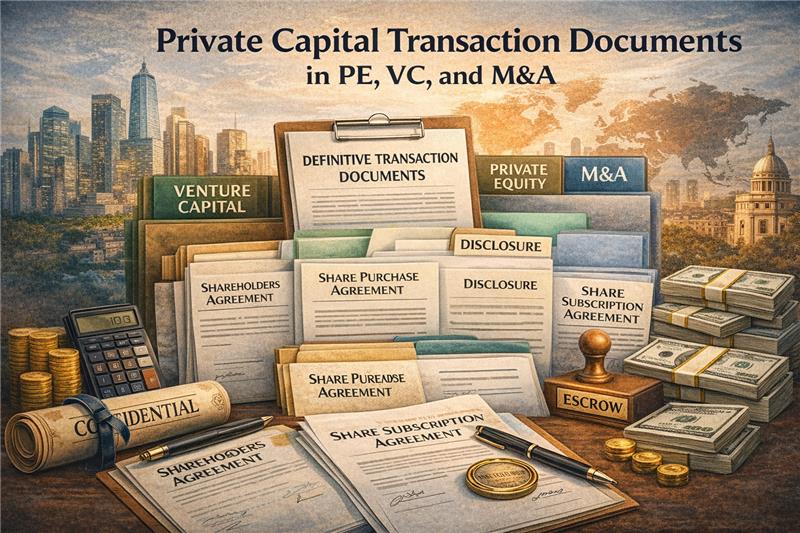
Private capital no longer moves on trust alone. It moves on paper. Every private capital transaction, whether structured as venture capital transactions, private equity transactions, or a Mergers and Acquisitions transaction, ultimately rests on enforceable agreements that convert negotiation into obligation. Funding announcements tend to highlight valuation, growth, or strategy. The actual control of the relationship sits elsewhere. Inside definitive transaction documents. These agreements dictate who controls decisions, who bears risk, and who walks away with value when the exit arrives.
For founders, these documents influence ownership longevity and operational authority. For investors, they protect capital, downside exposure, and exit certainty. The implications are not abstract. They determine real outcomes. This discussion examines definitive documents as they operate within a private capital transaction: their structure, purpose, clause architecture, and functional differences across venture capital transactions, private equity transactions, and a Mergers and Acquisitions transaction.
What Defines a Private Capital Transaction
A private capital transaction refers to an investment or acquisition involving privately held equity, executed through negotiated agreements rather than public markets. The structure varies, but the legal mechanics converge.
There are three dominant forms:
- Venture capital transactions — investments into startups or emerging growth companies, usually involving minority stakes.
- Private equity transactions — growth investments, buyouts, or control acquisitions targeting scaling or mature businesses.
- Mergers and Acquisitions transaction — transfer of shares or assets resulting in change of ownership or operational control.
Different motivations. Different timelines. Yet the same endpoint: definitive documentation that formalizes binding commitments.Without these documents, nothing is final. Term sheets signal direction. Definitive agreements impose consequence.
Definitive Transaction Documents: The Legal Core
Definitive transaction documents are the final binding contracts executed after due diligence, valuation alignment, and commercial negotiation. They convert negotiated expectations into enforceable rights.
Typical components include:
- Shareholders Agreement (SHA)
- Share Subscription Agreement (SSA)
- Share Purchase Agreement (SPA)
- Disclosure letters
- Escrow agreements
- Employment agreements
- Restrictive covenant agreements
Each serves a distinct legal function. Together, they construct the full legal framework of the private capital transaction. If the term sheet outlines the skeleton, definitive documents supply muscle and nerve.
Why Definitive Documents Carry Structural Importance
Capital enters. Control shifts. Liability attaches. Definitive documents regulate all three simultaneously.
They serve several essential functions:
- Allocate operational and financial risk
- Protect investors from hidden liabilities
- Establish governance authority
- Preserve founder protections where negotiated
- Define exit execution mechanisms
- Limit future disputes through defined remedies
- Allocate liability through indemnity provisions
Ambiguity in drafting rarely remains harmless. It surfaces later as conflict over valuation adjustments, board authority, or exit rights. Litigation often traces back to language that seemed acceptable during negotiation. Precision prevents reinterpretation.
Primary Definitive Documents in a Private Capital Transaction
1. Shareholders Agreement (SHA)
The Shareholders Agreement governs the ongoing relationship between shareholders. It becomes operational immediately after closing and continues throughout the investment lifecycle.This agreement is central in venture capital transactions and private equity transactions where investors enter an existing company structure.
It typically governs:
- Equity ownership structure
- Board composition and appointment rights
- Voting thresholds
- Reserved matters requiring investor consent
- Transfer restrictions
- Anti-dilution protection
- Exit rights including drag-along and tag along provisions
- Founder obligations and lock in periods
- Deadlock resolution mechanisms
The SHA controls future conduct. It does not fund the investment. It governs what happens after funding
Control rarely appears in headlines. It appears here.
2. Share Subscription Agreement (SSA)
The SSA governs issuance of new shares by the company to the investor. It appears frequently in venture capital transactions and expansion stage private equity transactions. It addresses the mechanics of capital infusion:
- Number of shares issued
- Subscription price and valuation
- Investor payment obligations
- Conditions required before closing
- Representations and warranties by the company
- Closing procedures
- Indemnity provisions
The SSA governs entry of capital. Without it, investment has no execution pathway.
Money flows because this agreement permits it.
3. Share Purchase Agreement (SPA)
The SPA governs transfer of existing shares from seller to buyer. It is the primary agreement in a Mergers and Acquisitions transaction and private equity buyouts.It regulates ownership transfer, not share issuance.
Key provisions include:
- Purchase price and payment structure
- Adjustment mechanisms
- Seller representations and warranties
- Indemnification obligations
- Closing deliverables
- Escrow arrangements
- Post-closing obligations
Ownership changes hands through the SPA. The SHA may follow to regulate future governance, but the SPA completes the acquisition itself.
Critical Clauses That Define Risk and Control
Certain provisions determine the practical balance of power in a private capital transaction. Their wording often receives disproportionate negotiation attention.
Conditions Precedent
Conditions precedent specify requirements that must be satisfied before closing.
These may include:
- Regulatory approvals
- Corporate authorizations
- Completion of due diligence
- Rectification of compliance issues
- Execution of ancillary agreements
Failure to satisfy conditions prevents closing entirely.
This clause protects against premature obligation.
Representations and Warranties
These are factual assurances made by one party to another. Investors rely heavily on them.
Typical coverage includes:
- Corporate authority
- Financial statement accuracy
- Absence of undisclosed liabilities
- Tax compliance
- Intellectual property ownership
- Litigation status
- Employment compliance
Inaccurate representations trigger liability through indemnity provisions.
These statements function as risk allocation tools.
Indemnity Provisions
Indemnity clauses allocate financial responsibility for losses arising from breach, misrepresentation, or undisclosed risk.
Indemnity provisions typically define:
- Liability caps
- Survival periods
- Monetary thresholds
- Escrow arrangements securing claims
In private equity transactions and a Mergers and Acquisitions transaction, indemnity negotiation often becomes one of the most contested areas.
It defines who absorbs hidden damage.
Restrictive Covenants
Restrictive covenants prevent founders or sellers from undermining the business after investment or acquisition.
Common restrictions include:
- Non-compete obligations
- Non-solicitation of employees or customers
- Confidentiality obligations
- Restrictions on disparagement
These provisions protect enterprise value, especially after ownership transfer.
Without restriction, exit protection weakens.
Governance and Control Rights
Investors frequently negotiate governance provisions ensuring visibility and influence.
These include:
- Board representation
- Observer rights
- Approval rights over key business decisions
- Veto authority on specified matters
These provisions appear prominently in venture capital transactions and become even more pronounced in private equity transactions involving significant ownership. Ownership percentage alone does not determine control. Governance provisions do.
Exit Rights and Liquidity Mechanisms
Exit provisions define how investors convert ownership into realized returns.
Typical mechanisms include:
- Initial Public Offering (IPO)
- Strategic acquisition
- Buyback rights
- Drag-along rights forcing minority sale participation
- Tag-along rights protecting minority shareholders
- Put and call options
These clauses determine exit feasibility long before exit occurs.
Returns depend on enforceability of these provisions.
How Definitive Documents Differ Across Transaction Structures
Venture Capital Transactions
Focus remains on minority protection and founder continuity.
Common features include:
- Anti dilution protection
- Founder vesting provisions
- Information rights
- Transfer restrictions
- Exit participation rights
Control exists but remains balanced.
Investors protect upside while preserving operational continuity.
Private Equity Transactions
Private equity transactions often involve deeper operational influence or outright control.
Typical features include:
- Board control or veto authority
- Strong indemnity coverage
- Extensive compliance representations
- Structured exit provisions
Private equity investors anticipate active involvement.
Documentation reflects that expectation.
Mergers and Acquisitions Transaction
In a Mergers and Acquisitions transaction, emphasis shifts toward ownership transfer certainty and liability protection.
Documentation commonly includes:
- Extensive seller warranties
- Purchase price adjustment mechanisms
- Escrow or holdback provisions
- Transitional operational arrangements
The objective is complete ownership transfer without hidden liabilities.
Risk transfer must be clean.
Where Definitive Documents Sit Within the Investment Lifecycle
The lifecycle of a private capital transaction typically follows this sequence:
- Target identification
- Confidentiality agreement execution
- Term sheet negotiation
- Due diligence review
- Drafting definitive agreements
- Signing definitive agreements
- Satisfaction of closing conditions
- Closing execution
- Post-closing compliance and governance
Definitive documents occupy the center of this process. They represent the irreversible commitment stage.
Everything before them remains provisional.
Consequences of Weak or Incomplete Drafting
The consequences of defective drafting surface gradually.
Common outcomes include:
- Governance disputes
- Investor dilution disputes
- Exit obstruction
- Regulatory violations
- Tax exposure
- Litigation
Most disputes do not originate from bad intent. They originate from incomplete drafting.
Clarity prevents reinterpretation.
Practical Examples Illustrating Definitive Documents
Venture Capital Investment Scenario
A startup raises Series A funding.
Executed documents include:
- Share Subscription Agreement
- Shareholders Agreement
- Disclosure letter
The SSA governs capital infusion mechanics. The SHA governs governance, rights, and exit structure.
Together, they complete the private capital transaction.
Private Equity Buyout Scenario
A private equity fund acquires majority ownership.
Executed documents include:
- Share Purchase Agreement
- Shareholders Agreement
- Escrow agreement
The SPA transfers ownership. The SHA defines governance and exit control.
Ownership and operational authority align through documentation.
Mergers and Acquisitions Transaction Scenario
Company A acquires Company B completely.
Executed documents include:
- Share Purchase Agreement
- Disclosure schedules
- Escrow agreement
- Employment agreements
- Restrictive covenant agreements
The SPA functions as the core document governing ownership transfer.
Supporting agreements preserve business continuity.
Drafting Discipline: Non-Negotiable Standards
Effective drafting requires alignment between commercial intent and legal execution.
Key practices include:
- Maintaining consistency across agreements
- Defining key terms precisely
- Avoiding vague indemnity language
- Specifying timelines and obligations clearly
- Aligning definitive agreements with term sheet intent
- Ensuring regulatory compliance
Definitive documents do not tolerate approximation. Ambiguity weakens enforceability.
Legal structure must reflect business reality exactly.
Conclusion
A private capital transaction reaches completion through executed definitive agreements and not through negotiation, announcements, or capital transfers alone. Whether structured as venture capital transactions, private equity transactions, or a Mergers and Acquisitions transaction, definitive documents establish enforceable ownership, governance, liability, and exit rights. For founders, these agreements determine long term authority and dilution exposure. For investors, they determine capital protection and exit certainty.
Definitive transaction documents do not sit at the margins of a transaction. They define it. Careful structuring, disciplined drafting, and strategic alignment are essential at every stage of execution an approach that CorporateLegit consistently applies when advising on complex private capital transactions across growth, control, and acquisition scenarios.